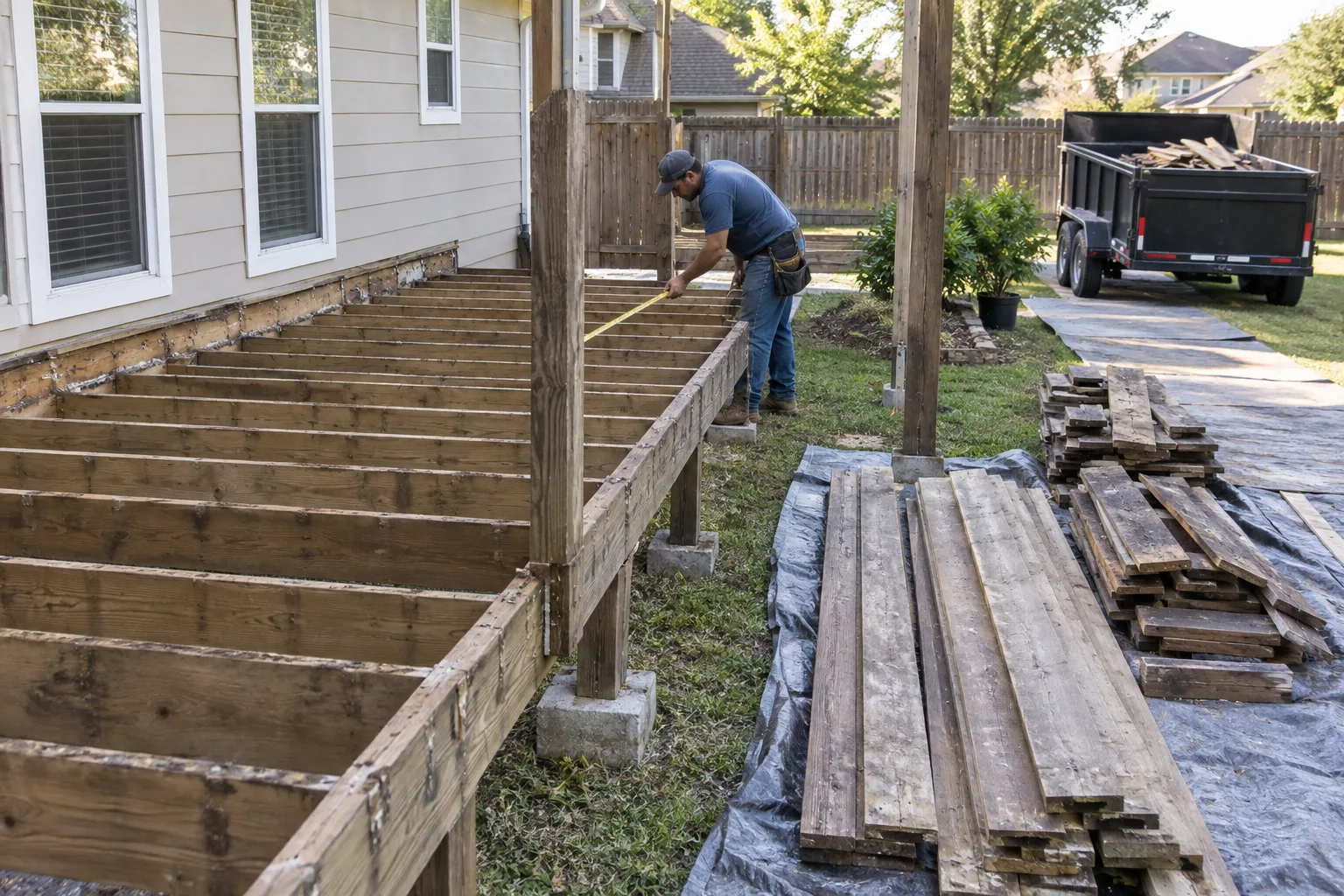
Before an old deck comes down, identify how it connects to the house, what runs below it, whether posts and footings stay, and how long boards will reach the loading area. Those four questions define much of the work.
Start where the deck meets the house
An attached deck commonly meets the house at a ledger. Removing that connection can expose damage or unfinished surfaces that were hidden behind the deck. Photograph the connection from below and at each end. If the attachment is unclear, treat it as an inspection question rather than guessing.
Deck condition matters too. The U.S. Consumer Product Safety Commission advises checking decks for loose hardware, rot, and eroding foundations, and suggests professional inspection where possible. A deck that is unsafe to use may also be unsafe to walk on during assessment. [CPSC outdoor repairs checklist]
Map what is under and through the deck
Look for electrical circuits, gas lines, hose bibs, irrigation, drains, HVAC equipment, and pool or spa connections. Do not dismantle around an unidentified line. A qualified trade may need to disconnect or protect part of the system before deck removal.
| Question | Decision it controls |
|---|---|
| Attached or freestanding? | How the frame is separated and what surface may be exposed. |
| Ground-level or raised? | Fall protection, carrying, and access beneath the structure. |
| Posts cut, pulled, or left? | Excavation, concrete handling, and the final ground condition. |
| Wood or composite? | Weight, fasteners, breakage, and disposal sorting. |
Define the finish line
“Remove the deck” can mean boards and rails only, the full wood frame, posts cut at grade, posts and concrete footings removed, or the entire area cleared for a new build. Put that finish line in writing. If a new contractor needs existing footings or the ledger, coordinate before either crew starts.
Measure the debris route
Long joists and rails need turning room. Measure gate width and note stairs, narrow side yards, landscaping, soft ground, and air-conditioning equipment. Show the proposed trailer position. A short direct route and a long hand-carry route are not the same job.
Before the work date
- Keep people and pets out of the work area.
- Move furniture, grills, planters, and loose items.
- Confirm utility status and any property-specific approval.
- Mark what must remain, including steps, slab, ledger, posts, or nearby finishes.
- Agree on debris, fasteners, and the expected cleanup.
Sources were reviewed on September 28, 2026. Rules, site conditions, and service scope can change. Confirm current requirements with the responsible authority and the people performing the work.